By Tunji Faleye
It’s a well-known fact that running a business means weaving marketing strategies into the mix to build customer loyalty and turn that loyalty into actual sales. Interestingly, while marketing has been around as long as humans have, it has evolved significantly over time. From the simple word-of-mouth used by Eve to convince Adam to try that apple in the Garden of Eden, we have moved into the era of digital marketing.
With the rise of the Internet, email marketing took off, and digital marketing capabilities expanded rapidly. Then, came influencer marketing, which became the latest trend, allowing brand managers and marketers to come up with innovative ways to connect with consumers.
Surprising, sometimes the leadership within organizations do overlook the importance of marketing for their brands and the overall health of the company. This often happens when they decide to slash marketing budgets during tough times when there is a drop in profits.
While there might be valid reasons for budget cut, recognizing the crucial role of marketing in brand building should be the top priority when determining how much to allocate for marketing. This is why many well-known brands set aside a significant portion of their resources for it, even though they are already household names worldwide. Take Coca-Cola, for instance; the organization invests heavily in marketing to keep it brands fresh with top-of-the-mind awareness. The same goes for 7Up, Apple, Samsung, and numerous other famous brands. Some of these companies actively promote their brands to maintain market dominance and grow their marketshare for as long as they can.
In recent years, a few brands in Nigeria employed aggressive marketing with the aim of controlling their respective sectors. A closer look at those brands introduced showed that their launch into the market was possibly to stifle competitors. Once they fulfilled their intended purpose, they either faced immediate shutdown or were left to stay afloat with their rivals to face market realities.
Pepsi’s onslaught
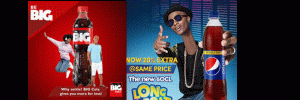
In 2015, one of the world’s leading cola brand employed a disruptive marketing strategy by introducing Pepsi 60cl Longthroat into the Nigerian market. By that period, it used to be a serious competition in the Carbonated Soft Drink (CSD) category between Pepsi and Coca-Cola. However, the Latin America-based Big Cola, a new entrant into the market increased the tempo of the competition following the introduction of revolutionary plastic polyethylene terephthalate (PET) which enables easy access for other competitors to come into the sector.
Seeing this as a major challenge, 7up Bottling Company launched Pepsi 60cl Longthroat to checkmate the rate at which consumers were drifting toward Big Cola.
Few weeks after the launch of Pepsi 60cl Longthroat, it became an instant success in the market controlling marketshare more than Big Cola. It had been described a war chest marketing strategy, increasing the volume by 20 per cent at the same price for consumers.
The handlers of Pepsi Cola took their legs off the throttle after realizing that their new brand had completely captured the market share. However, the organization relaunched 60cl LongThroat bottle recently with another disruptive marketing campaign, tapping into the fabric of pop culture, Big Big Tinz (Big Refreshment. Big Value) message to deepen its connection with consumers.
Speaking on the release of the new theme song then, the Senior Brand Manager of Seven-Up Bottling Company, Sam Okolie, noted that the choice of “Big Big Tinz” aligned perfectly with the return of Pepsi 60cl product value and resonated with its youthful audience.
“As a brand, we will continue to be at the forefront of driving contemporary pop culture, engaging the right partners and platforms to send our message, drive connection, and dial-up affinity for the brand. Crafting such a compelling message ‘Big Big Tinz’ to communicate the relaunch of our 60cl Longthroat bottle was a natural fit. Nigerians have a unique style of expressing their bold cravings, big desires, and dreams…,” Okolie said.

GOtv versus StarTimes
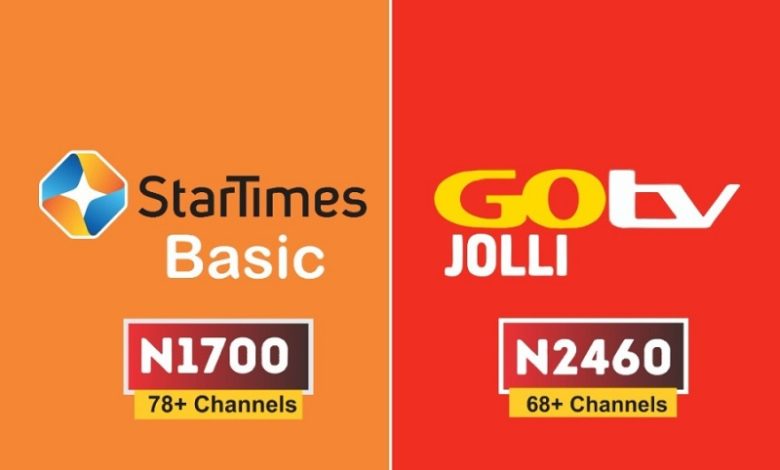
Another interesting marketing war occured in the PayTv industry. How? StarTimes was officially launched in Nigeria on July 29, 2010 in partnership with Nigerian Television Authority (NTA). Until the launch, the PayTv subsector of the nation’s economy was more or less an exclusive preserve for MultiChoice with its DStv, with array of bouquets. Though, some PayTv brands tried to break the monopoly, many of them suffered insolvency and left the industry abruptly.
Remarkably, more than a year StarTimes began operation in the country following the federal government’s effort to switch over from analog to digital broadcasting, GOtv also joined the fray.
In October 2011, MultiChoice introduced GOtv into Nigerian market as an affordable digital terrestrial television (DTT) service, utilizing DVB-T2 technology.
Market analysts said what necessitated MultiChoice to introduce GOtv into the market was for obvious reason. It was a direct response to StarTimes’ disruption of the industry, as some subscribers changed over to the brand, because of the low-cost of StarTimes set, easy-to-set up system, and cheaper subscription rates.
For MultiChoice, leaving StarTimes to have control of the market may be a major mistake that would have impacted negatively on its subscriber base and profit, but with aggressive marketing, cheap GOtv components, moderate subscription rates, and better bouquet, GOtv was able to gain enough market share in the industry.
Fearless and Predator’s struggle
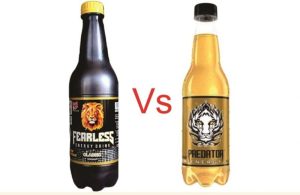
Also, Nigeria Bottling Company (NBC) in June 2020 launched Predator Energy Drink into the Nigerian market. The launched was accompanied by media hype and marketing strategies that suited any brand coming from NBC.
Predator Energy Drink is an affordable, caffeinated beverage designed to boost energy, focus, and performance for athletes, gamers, and professionals. It features a “fierce” flavour, containing caffeine, taurine, and B-vitamins, typically available in 40cl bottles or 250ml cans.
Industry watchers said Predator Energy Drink purposely entered the market to gain the marketshare of the energy drink sector. This was so, when considering that Fearless, a popular Nigerian non-alcoholic energy drink launched in 2017 by Rite Foods had been in the market and doing well, providing energy and focus for consumers’ active lifestyles.
While launching the Fearless brand in 2017, Rites Foods released a statement saying: “we believed in one simple yet powerful idea: life’s greatest adventures demand more than ordinary energy, they demand courage. That is why we created Fearless, a proudly Nigerian, award-winning energy drink designed to fuel curiosity, discovery, and the unstoppable drive to explore.”
The next stage of the marketing war between NBC and Rites Food took another dimension with pricing power-play. Predator’s pricing mechanism gave it a significant presence in the energy beverage industry. In spite inflationary pressure, Predactor entered the market with N250 price tag, the same with Fearless. Analysts identified this strategy as a way to gain market presence, which worked perfectly for the brand.
Notwithstanding the launch of predator, the two brands (Predator and Fearless) continued to gain significant market share via different marketing strategies. What followed this was a legal tussle following a trademark infringement law suit Rites Food instituted against NBC.
Expert opinions
Analysts say while brands have the right to employ different marketing strategies to promote their products, they should encourage healthy competition that will improve the industry. Kehinde Adegoke, a brand strategist, publisher and managing editor of The Digger News based in Ibadan, Oyo State capital said, “brands will always fight for marketshare but, caution must be taken to guide against anti competition strategies.”
What is your take on this story?