What Nigeria’s growth forecast raised to 4.2% by IMF means for citizens, economy

By Tunji Faleye
The International Monetary Fund‘s recent decision to push up Nigeria’s economic growth forecast for 2026 to 4.2 percent is a promising sign for the country’s economy. However, the real question is whether this growth will actually lead to improved living conditions for Nigerians. That largely hinges on how it affects household incomes, food prices, job opportunities, and the overall cost of doing business.
In its 2026 World Economic Outlook, aptly titled “Resilience Under Strain, Urgent Choices,” the IMF also anticipates that Nigeria’s economy will grow by 4.3 percent in 2027. This report was unveiled in Bangkok, Thailand.
The updated projection for 2026 marks a slight increase of 0.1 percentage points from the Fund’s previous estimate, while the 2027 forecast remains steady.
While this adjustment suggests a brighter outlook, it’s important to keep the numbers in perspective. Economic growth reflects the increase in economic activity, but it doesn’t necessarily mean that households are getting richer or that living costs are going down.
For Nigeria, the key question is whether this anticipated growth can bring real benefits to citizens who are still grappling with soaring food prices, escalating energy costs, and squeezed disposable incomes.
Growth outlook signals improved economic conditions
The IMF has pointed to Nigeria’s growth outlook as a sign of better economic times ahead, thanks to improvements in macro-economic stability and favuorable trade conditions. If these positive trends continue, they could really boost production, investment, and overall economic activity.
When macroeconomic stability is in place, it creates a more predictable landscape for businesses and investors. With consistent economic policies and a focus on addressing major imbalances, companies can more easily plan their investments, manage costs, and make decisions about expanding their operations.
Favourable trade terms can also play a significant role, especially when the prices of what a country exports are higher than the costs of what it imports.
Interestingly, for Nigeria, the real challenge lies in effectively translating these improved conditions into tangible benefits like stronger domestic production, job creation, and increased household incomes. The IMF has also raised concerns about the rising prices of essential goods, which could worsen poverty and food insecurity. This presents a significant challenge for policymakers on how to maintain economic growth while ensuring that the most vulnerable members of society aren’t left behind.
Will the economic growth really boost purchasing power?
One of the key takeaways from the forecast is the need to differentiate between overall economic growth and the actual improvement in people’s living standards.
An economy can grow while many families still face financial hardships. This often occurs when growth is focused on sectors that don’t create many jobs, when income increases are not shared fairly, or when inflation eats away at the purchasing power of both workers and business owners.
For everyday Nigerians, the real value of economic growth will be seen in tangible results. Can families easily afford food and transportation? Are businesses hiring more people? Are
wages keeping up with the rising cost of living? Can households cover essential expenses without having to cut back on other important needs?
These are the crucial questions that will reveal whether the expected growth translates into something meaningful beyond just numbers.
If growth results in more productive businesses, new job opportunities, and better pay, families might gradually see improvements in their financial situations. However, if prices keep climbing faster than wages, the advantages of a growing economy may remain out of reach for many citizens.
IMF calls for targeted support for vulnerable households
The IMF’s caution regarding the rising costs of essential goods highlights the need for policies that tackle both economic growth and the immediate challenges that households are facing.
The IMF urged the Federal Government to step up and provide targeted support for vulnerable households as part of its latest growth forecast. They’re suggesting temporary cash transfers to help Nigerians who are struggling with the rising costs of food and energy. Deniz Igan, a division chief in the IMF’s Research Department, shared this recommendation during a report presentation..
Igan emphasized the need for policymakers to offer immediate help to those feeling the financial squeeze, all while keeping an eye on long-term economic stability. She highlighted the importance of more efficient public spending and better revenue collection to ensure that this support can be sustained financially.
This recommendation underscores the challenge of balancing necessary economic reforms with the social impact of increasing living costs. Targeted cash transfers could really help low-income households cover their essential expenses. Unlike broad subsidies that might also benefit wealthier individuals, well-structured cash assistance can ensure that public funds are directed to those who truly need it.
However, the success of such a program hinges on accurately identifying who qualifies, delivering payments in a transparent manner, and making sure that help reaches recipients without delay. Funding is another critical issue. With various demands on public finances, the government will need to create a sustainable financing plan instead of rolling out support measures that could add to fiscal pressures.
So, the IMF isn’t just calling for more government spending; they’re advocating for a more focused approach to social protection while keeping a tight rein on public resource management.
The debate over petrol subsidies
The conversation around targeted assistance is heating up as the government grapples with the ongoing cost-of-living crisis. Opposition leaders Atiku Abubakar and Peter Obi are urging President Bola Tinubu’s administration to bring back some petrol subsidies to help ease the financial strain on families and businesses.
Supporters of these subsidies argue that lowering fuel prices could help cut transportation costs and make it cheaper to move food and other essential goods. However, there are valid concerns about the financial burden on the government, how benefits are distributed, and whether spending public money on price support is the best use of resources compared to funding other vital services.
The IMF suggests a different targeted assistance. This approach aims to soften the blow of rising prices while still keeping the focus on economic stability.
It’s crucial to evaluate both strategies not just by their intentions but by how effectively they deliver relief to those in need, their costs, sustainability, and whether they genuinely improve household welfare.
In a related move, the Federal Government has introduced a 30-day discount period for petrol sold by the Nigerian National Petroleum Company Limited, prioritizing public transport operators. Finance Minister Taiwo Oyedele explained that this discount would come from the retailer’s margins, not public funds. He dismissed claims that this was a step back towards petrol subsidies, although critics have raised eyebrows at that assertion.
This initiative highlights the ongoing quest to lower transportation costs without straining the public purse. The real impact will depend on how much of the discount gets passed on to transport operators and, ultimately, to the commuters who rely on them.
World Bank forecast also points to expansion
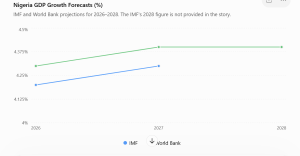
The World Bank‘s latest forecast suggests a positive outlook for Nigeria’s economy, predicting a growth of 4.3 percent in 2026, followed by 4.4 percent in both 2027 and 2028. This optimistic projection aligns with the IMF’s recent upward revision. Additionally, data from the National Bureau of Statistics shows that the economy experienced a real GDP growth of 4.43 percent year-on-year in the second quarter of 2026, a slight increase from 4.23 percent during the same period in 2025.
These numbers indicate a trend of ongoing economic growth, though the variations in forecasts highlight the different assumptions and evaluations that each institution uses. The real challenge lies in maintaining this growth while bolstering sectors that can create jobs, enhance productivity, and boost domestic value.
Relying on a narrow range of industries for growth may not yield widespread benefits. To ensure that the advantages of growth are felt more broadly, it’s essential to focus on increasing agricultural productivity, enhancing manufacturing, supporting small and medium-sized enterprises, and improving the overall business climate. For businesses, a more stable economic landscape could open doors for investment and expansion. However, challenges like high operating costs, fluctuating consumer demand, and pressure on household spending may still hinder growth in certain areas.
Nigeria’s growth in a challenging global economy
The IMF’s projections also place Nigeria’s outlook within a wider global economic environment.
The Fund expects global economic growth of 3.1 per cent in 2026 and 3.4 per cent in 2027. It projects headline inflation at 4.7 per cent in 2026 before easing to 4.1 per cent in 2027.
For Nigeria, international economic developments matter because they can influence export earnings, import costs, investment flows and domestic prices.
External shocks that increase the cost of energy, food or other imported inputs could put additional pressure on households and businesses. Conversely, favourable trading conditions could support export earnings and economic activity.
This makes the management of domestic vulnerabilities particularly important. Stronger local production, improved infrastructure, efficient public spending and a predictable policy environment could help the country withstand external pressures.
What the forecast means for the Tinubu’s administration
The recent upward revision presents a promising economic signal for the Federal Government, but it also sets the bar high for the quality and distribution of that growth. To keep this momentum going, it’s going to take more than just optimistic forecasts. Policymakers must ensure that economic reforms are geared towards boosting investment and productivity, all while tackling the challenges that households and businesses are facing.
One crucial aspect of this effort is revenue mobilization. By enhancing revenue collection, the government can gain the resources needed to invest in infrastructure, education, healthcare, and social protection. However, it’s essential that this improved collection is paired with transparent spending and clear evidence that public funds are yielding positive outcomes.
Additionally, the government should evaluate whether current social support programs are effectively reaching those who need them most and if measures like the temporary fuel discount are genuinely providing relief.
For everyday citizens, the true measure of economic progress goes beyond just the growth rate; it’s about whether the economy is generating more opportunities, supporting livelihoods, and making essential goods and services more affordable.
Do you think this new forecast will boost the purchasing power of the citizens?