Beyond the stock boost: How Nestle is powering Nigeria’s rural economy and the future of West African commerce

By Tunji Faleye
From neighbourhood provision stores in Kaduna to informal trading networks across West Africa, women play a vital role in moving goods, earning household incomes and keeping community commerce going. Nestlé Nigeria’s five-year Empowering Rural Women Initiative offers a chance to explore why investing in these entrepreneurs could make a difference well beyond their individual businesses.
In many Nigerian communities, retail doesn’t start in a supermarket, shopping mall or organised distribution centre. It starts at the neighbourhood provision store, the small kiosk on a residential street, the market stall—and with the woman who knows her customers, understands what they buy and makes sure everyday essentials are close at hand.
These women are often the most familiar faces of commerce in their communities. They serve customers with limited access to larger outlets, work with modest inventories and rely on daily sales to run their businesses and support their families.
But their contribution comes with a persistent challenge: many small-scale women retailers have little access to business training, affordable finance, structured mentorship or the resources to grow beyond subsistence trading.
That raises an important question for grassroots commerce in Nigeria and across West Africa: how can women who already keep local distribution networks running build businesses that are more profitable, resilient and sustainable?
Nestlé Nigeria’s Empowering Rural Women Initiative is one effort to address that challenge.
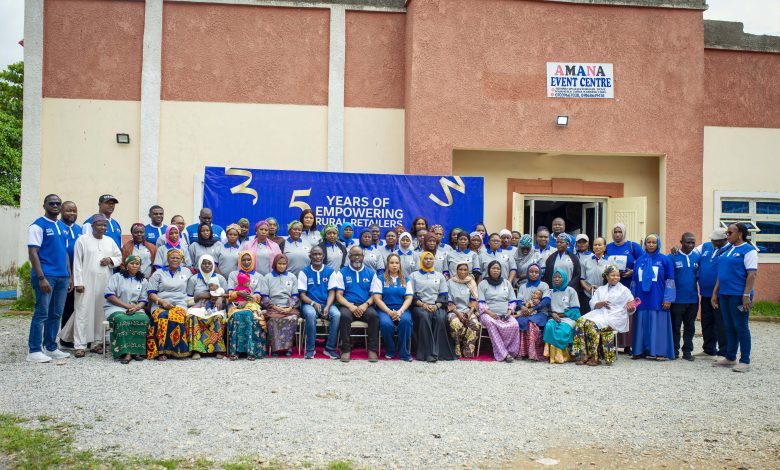
Launched in 2021, the programme recently marked its fifth anniversary and 10th edition in Zaria, Kaduna State. At the event, 50 more women retailers received business training and product support worth three times the value of their existing stock.
With this latest intervention, the initiative has reportedly supported 482 women across Nigeria, following the addition of the Zaria participants to the 432 beneficiaries reached in previous editions.
Beyond the immediate support, however, the programme raises a wider development issue about the relationship between women-led microenterprises, rural economic participation and the strength of consumer distribution networks.
The economics of the neighbourhood retailer
Broader labour-market and enterprise data show just how important women are to Nigeria’s informal retail economy.
A January 2026 country report from the European Union Agency for Asylum, based on data from Nigeria’s National Bureau of Statistics, estimates that about 93 per cent of employment in Nigeria was informal in June 2024. The share was even higher for women: 96 per cent, compared with 90 per cent for men. In rural areas, the informality rate reached 97.5 per cent. While these figures cover informal employment as a whole—not retail specifically—they highlight how much women’s livelihoods depend on small-scale economic activity.
Women also play a major role in Nigeria’s microenterprise sector. World Bank research estimates that they own around 40 per cent of the country’s micro, small and medium-sized enterprises.
But owning a business doesn’t guarantee equal opportunities to grow. The World Bank found that 52 per cent of women-led businesses considered access to finance a major constraint, compared with 30 per cent of male-led businesses. Women-led firms in the study were also much more likely to have their loan applications rejected.
For a woman running a small retail outlet, that financing gap can have an immediate impact.
She may know what her customers want, which products are most profitable and how to keep them coming back, but still lack the working capital to buy enough stock. She may also find it difficult to keep household and business spending separate, maintain accurate records or negotiate better terms with suppliers.
Even when customers are ready to buy, these challenges can hold a business back.
That’s why support that combines business training, mentorship and access to working capital can make a real difference.
Nestlé Nigeria’s involvement goes beyond getting products into shops. Its Zaria programme pairs extra inventory with practical training in bookkeeping, merchandising, stock control, financial management and customer service.
That distinction matters. More stock may offer temporary relief, but it won’t necessarily help a business grow over time. When retailers can track sales, manage inventory, understand their finances and reinvest their profits, they’re in a stronger position to build lasting businesses.
From Zaria to Nigeria’s wider retail landscape
While the latest edition was held in Zaria, the challenges it addresses are found well beyond Kaduna State.
Across Nigeria’s six geopolitical zones, women earn a living through many kinds of neighbourhood businesses, including grocery shops, market stalls, food distribution, household goods retail and other microenterprises.
In the South-West, especially in Lagos and nearby commercial hubs, women work in highly competitive retail markets. Keeping customers, maintaining product availability, setting prices and managing stock efficiently can all make a difference to whether a business survives.
In the South-East, strong trading networks and busy markets create opportunities for women entrepreneurs distributing consumer goods and household essentials.
In the South-South, small retailers serve communities linked to urban markets, coastal settlements and local distribution networks. Their businesses rely on goods being available, transport running smoothly and customers having enough purchasing power.
Across Northern Nigeria, including Kaduna, Kano, Katsina, Sokoto and other commercial centres, women work in a range of retail and small-business sectors. Their opportunities and day-to-day conditions, however, differ from one community to another.
These regional differences matter. An effective empowerment programme cannot assume that every woman entrepreneur faces the same challenges.
A retailer in a densely populated Lagos neighbourhood may need help with digital payments, standing out from the competition and keeping stock moving. A trader in a rural community, by contrast, may be more concerned with finding suppliers, transport, working capital and dependable market information.
That’s why business development support needs to reflect local economic realities, rather than rely on a one-size-fits-all training model.
The International Labour Organization’s assessment of women’s entrepreneurship development in Nigeria points to several conditions that support sustainable business growth: access to gender-sensitive financial services, business development support, markets and technology.
This suggests programmes such as Nestlé’s could have a greater impact if they were connected to a wider network of financial institutions, government agencies, business associations and other private-sector organisations.
A West African opportunity that reaches beyond national borders
The importance of women’s participation in grassroots commerce becomes clearer when we look beyond Nigeria.
Across West Africa, women are central to local markets, informal distribution networks and small-scale cross-border trade. Their businesses link producers, wholesalers, retailers and consumers across national borders.
In Ghana, for instance, market women have long played a prominent role in the informal urban economy. Research published in the *Journal of Science and Technology* on traders in Kumasi’s Central Market and Race Course markets found that they contribute to household incomes, job creation, food security and local economic activity.
The study also highlighted persistent challenges, including poor market infrastructure, transport difficulties and limited access to credit.
Their experience points to a wider reality: women traders may be commercially skilled and economically active, yet still lack the infrastructure and financial resources required to expand their enterprises.
A World Bank-supported regional gender assessment of small-scale cross-border trade offers a broader view of the challenges women face.
The research covered six major West African trading corridors:
– Dakar–Bamako, connecting Senegal and Mali.
– Abidjan–Ouagadougou, connecting Côte d’Ivoire and Burkina Faso.
– Ouagadougou–Tema, linking Burkina Faso and Ghana.
– Lomé–Ouagadougou, connecting Togo and Burkina Faso.
– Cotonou–Niamey, connecting Benin and Niger.
– Lagos–Kano–Niamey, linking Nigeria and Niger.
The study drew on 2,999 quantitative interviews, as well as interviews with key informants and focus group discussions. It explored the experiences of small-scale traders, including women.
The findings show that women’s role in regional commerce goes well beyond selling goods in their local communities. Many are part of trading networks that carry products between markets and across national borders.
But their work is often constrained by limited information about border procedures, difficulty accessing finance, low earnings, and other barriers to taking part in formal trade. Along some of the corridors studied, more than 80 per cent of women surveyed said they did not know what procedures to follow when crossing the border.
The assessment also included the Lagos–Niamey corridor, a key route connecting Nigeria and Niger. Its inclusion highlights how the challenges facing small-scale women traders can span national boundaries.
This regional evidence adds a wider perspective to the discussion of Nestlé’s initiative. Supporting women retailers is not just about helping individual businesses grow; it also means strengthening the networks that get products to consumers and sustain economic activity across communities.
What is happening elsewhere in West Africa?
Developments across the region suggest that governments and development institutions are paying growing attention to women’s businesses.
In Benin, for example, the World Bank announced a $100 million financing programme in January 2026 to support women entrepreneurs in both the formal and informal sectors.
The Women Entrepreneurship Development and Access to Finance Programme aims to help more than 10,000 women-led micro, small and medium-sized enterprises access loans, training, mentoring and business advice.
The World Bank has also reported that just 3.9 per cent of women-managed businesses in Benin had access to bank loans, highlighting the scale of the financing gap.
In Côte d’Ivoire, the World Bank has emphasised how digital entrepreneurship and financial inclusion can create new opportunities for businesses, including those led by women. Its work on the country’s digital financial services landscape identified financial exclusion as a challenge for individuals and small businesses, with women among those most affected.
Ghana offers another useful example of the link between market participation and digital inclusion. Market women there operate in a commercial environment where mobile money and other digital financial services are playing an increasingly important role in transactions.
Together, these experiences show that supporting women’s businesses across the region takes more than providing products or start-up capital. It also means improving access to financial services, building digital skills and business knowledge, and creating conditions in which small businesses can operate effectively.
The missing link: From business training to financial independence
A key part of Nestlé’s initiative is its three-month mentorship component.
For many small-scale entrepreneurs, attending a business training programme is just the first step. The real test comes when they return to work and try to put what they’ve learnt into practice.
Can they keep accurate sales records? Work out which products bring in the best returns? Avoid tying up too much cash in slow-moving stock? Set aside some of their profits to reinvest, rather than spending all their earnings?
These practical decisions can determine whether a small retail business simply gets by or grows sustainably.
That is why combining training with extra inventory and ongoing mentorship is an important feature of the programme.
Nestlé Nigeria says its monitoring of previous participants found that more than 80 per cent had sustained and grown their businesses beyond the initial stock support. The company also reports improvements in inventory levels, turnover, customer numbers and business-management practices.
These results are encouraging. Still, the figures would carry more weight if the company published details such as how many participants were assessed, the period covered, business survival rates and independently verified changes in income.
Greater transparency would help show the initiative’s long-term economic impact, beyond the immediate boost from increased stock.
It could also offer valuable evidence to other companies, development organisations and public institutions exploring similar programmes.
The role of corporate Nigeria in grassroots economic development
The initiative also prompts a broader question: what responsibility do large corporations have towards the small businesses that keep their distribution networks running?
For consumer goods manufacturers, independent retailers are more than just sales outlets. They are essential links between production and consumption. They provide market access, make products available in communities and maintain relationships with consumers that larger retail establishments may not easily replicate.
Nestlé Nigeria’s Commercial Manager, Boladale Odunlami, underscored this connection at the Zaria event, noting that women make up about 60 per cent of retailers in the company’s network.
He said the initiative reflects the company’s belief that women who help grow its business should also have the chance to build their own enterprises.
There is a clear business case for this. When retailers become more financially secure, manage stock more effectively and build stronger relationships with customers, the benefits can reach suppliers, distributors, manufacturers and consumers alike.
For Nestlé, investing in women retailers can strengthen its distribution network while supporting the economic well-being of the communities where it operates.
Victoria Uwadoka, Nestlé Nigeria’s Corporate Communications, Public Affairs and Sustainability Lead, described the programme as an example of Creating Shared Value—a business approach that links commercial success with positive social impact.
She argued that the initiative should be judged not just by the products given to participants, but by what the women go on to achieve.
That distinction matters in the wider conversation about corporate social responsibility and sustainability. Companies are increasingly expected to show measurable results, rather than simply report how many people they reached or how much they donated.
For a programme like this, meaningful measures might include whether businesses survive and grow, whether revenue and profitability improve, whether participants become more financially independent, whether jobs are created, and whether beneficiaries can keep their businesses going without ongoing outside support.
Ultimately, empowerment means helping people build progress they can sustain on their own.
Why the digital economy needs to be part of the conversation
Another issue worth addressing is the digital transformation of grassroots retail businesses.
Across Nigeria and West Africa, digital financial services are opening up new opportunities for small enterprises. Mobile payments, digital savings, electronic transaction records and online customer engagement can help retailers manage their businesses more effectively.
But simply having access to technology does not guarantee growth. Retailers also need to know how to use these tools to make sound business decisions.
For women who run small shops, digital bookkeeping can make it easier to tell the difference between sales and actual profit. Electronic payment records can also provide a transaction history that helps demonstrate business performance when applying for financial services.
This matters in Nigeria, where limited access to formal credit remains a significant barrier for women entrepreneurs.
Research by Women’s World Banking on Nigerian women micro-entrepreneurs points to the value of savings, financial management and financial products that reflect the realities of low-income women traders. It also highlights the role informal savings arrangements play in many entrepreneurs’ financial lives.
For Nestlé and other consumer goods manufacturers, adding digital financial literacy to existing retailer development programmes could offer an important extra layer of support.
It could help women move beyond cash-based record keeping and build more reliable financial histories. Retailers could also use digital tools to track inventory, understand what their customers are buying and plan future stock needs.
The ECOWAS perspective: Empowering women to drive regional integration
The Economic Community of West African States (ECOWAS) has increasingly recognised the importance of women’s participation in small-scale cross-border trade.
In June 2026, the ECOWAS Commission launched a Regional Fortnight on Small-Scale Cross-Border Trade by Women in Lomé, Togo, under the theme “Women Cross-Border Traders: Driving Regional Integration for 50 Years.”
The initiative celebrated women’s contribution to regional trade and highlighted the challenges they face, including limited access to finance, administrative hurdles, harassment and poor infrastructure.
ECOWAS estimates that women account for between 70 and 80 per cent of cross-border traders along several trade corridors in the region.
That matters because it brings women’s economic empowerment into the broader conversation about regional integration.
The success of the African Continental Free Trade Area and the growth of stronger regional markets will depend in part on whether smaller businesses can take part in both formal and informal trading networks.
Women retailers and traders play a vital role in these networks, but they need access to information, finance, business development support and reliable trading infrastructure.
For instance, a woman running a retail business in Kaduna may be part of a supply chain that reaches suppliers and commercial markets well beyond Nigeria.
Likewise, women traders in Ghana, Togo, Benin, Senegal and Côte d’Ivoire help move goods through local and regional markets.
Building their commercial skills and capacity can therefore support more inclusive economic activity across the region.
This does not mean that one corporate initiative can solve the structural challenges facing women traders across West Africa. Rather, it shows how effective private-sector programmes can complement government and
What should happen next?
Nestlé Nigeria’s five-year experience shows the promise of private-sector involvement in supporting women entrepreneurs. The next step is to build on that progress and make its impact deeper and more sustainable.
There are several ways to do this.
First, expand the programme geographically. Reaching more communities across Nigeria’s six geopolitical zones would help ensure that women retailers in underserved rural areas also have access to business development opportunities.
Second, improve access to finance. Product support can help retailers build up their stock, but they also need suitable financial services to cover regular operating costs and grow their businesses. Partnerships with financial institutions could help meet this need.
Third, strengthen digital business skills. Training in electronic bookkeeping, digital payments, savings and basic inventory management could help participants run their businesses more efficiently.
Fourth, improve impact measurement. Independent assessments of participants’ businesses before and after the programme would provide clearer evidence of its contribution to enterprise growth.
Fifth, explore partnerships across West Africa. Governments, development agencies, financial institutions, consumer goods companies and regional trade organisations could adapt similar approaches to the needs of women entrepreneurs in their own countries.
Ultimately, success should be measured by more than the number of women trained or products distributed. The key question is how many participants build businesses that can weather economic shocks, reach more customers, create jobs and provide a steady income for their households.
Beyond 482 women: The bigger picture
Five years after its launch, Nestlé Nigeria’s Empowering Rural Women Initiative has reached 482 women retailers, according to the company’s figures.
The addition of 50 women in Zaria marks another step in that journey.
But the initiative’s broader significance lies in what it says about the links between grassroots entrepreneurship, corporate responsibility and economic development.
Across Nigeria, women are more than participants in the informal economy. They own businesses, distribute goods, run markets and play a vital role in the consumer goods supply chain.
Their work also extends across West Africa, where trading networks connect markets, communities and national economies. Yet women’s economic contributions have not always been matched by access to the resources, infrastructure and institutional support they need to grow stronger businesses.
That’s why empowering women retailers should be seen as more than a corporate philanthropy project. It is an investment in the productive capacity of local economies.
Nestlé Nigeria’s five-year initiative offers a useful example of how a consumer goods company can align its commercial interests with the development of the small businesses that underpin its distribution network.
Its lasting value, though, will depend on whether the women involved can turn training, mentorship and extra inventory into steady profits and greater economic independence.
Ultimately, inclusive commerce in Nigeria and West Africa will depend on more than the performance of large manufacturers, financial institutions and multinational corporations.
It will also depend on the thousands of small businesses that bring products closer to consumers, create livelihoods and keep economic activity moving in their communities.
At the heart of many of these businesses are women whose entrepreneurial contributions deserve not only recognition, but sustained investment.