Okeahialam advocates deeper insurance, oil sector collaboration to unlock Nigeria’s digital economy

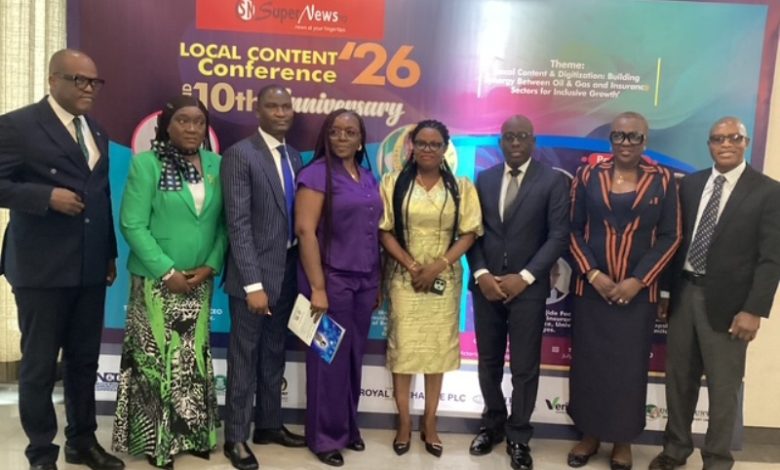
L-R: Managing Director/CEO, Guinea Insurance Plc, Mr. Ademola Abidogun; Deputy President, Nigerian Council of Registered Insurance Brokers (NCRIB), Mrs Olufunke Adenusi; Executive Director, Operations, Veritas Kapital Assurance Plc, Mr. Sunkanmi Adekeye; Managing Director, Deepshores Energy Limited, Mrs. Nneka Obi; Ngozi Onyeakusi, Publisher, SUPERNEWS; GeneralManager, Marketing, Universal Insurance Plc, Mr. Tunji Oyebajo; Group Managing Director/CEO, Royal Exchange Plc, Mrs. Idu Okeahialam; and Professor Olajide Fadun, Department of Insurance and Actuarial Science, University of Lagos at the 2026 SUPERNEWS Conference and 10th anniversary held in Oriental Hotel, Lekki Road, Lagos, on Tuesday, July 7, 2026.
By Ayodeji Babatunde
Nigeria’s drive for sustainable economic growth will require stronger collaboration between the insurance and oil and gas industries, with digital innovation and local capacity development serving as key enablers, Group Managing Director/Chief Executive Officer of Royal Exchange Plc, Mrs. Idu Okeahialam, has said.
Speaking as the keynote speaker at the SUPERNEWS Nigeria Local Content Confab 2026 and the organisation’s 10th anniversary celebration in Lagos, Okeahialam urged stakeholders to move beyond conventional business relationships and embrace strategic partnerships that can strengthen the nation’s economic resilience.
Addressing participants on the conference theme, “Local Content & Digitalisation: Building Synergy between the Oil & Gas and Insurance Sectors for Inclusive Growth,” she argued that Nigeria’s next stage of development should be anchored on innovation, institutional strength and collaboration among critical sectors of the economy.
Okeahialam observed that although Nigeria has made measurable progress in implementing local content policies within the oil and gas industry, greater emphasis should now be placed on expanding indigenous participation in financing, insurance, technology, technical expertise and enterprise risk management.
She described the insurance industry as a vital pillar of economic development, noting that it provides the confidence investors and businesses require to undertake large-scale projects, particularly within the capital-intensive oil and gas sector.
According to her, increasing the retention of insurance business within Nigeria would help build domestic capital, generate employment, expand professional expertise and strengthen the country’s financial services ecosystem.
“The relationship between the oil and gas and insurance sectors must evolve beyond a transactional arrangement into a strategic partnership. By strengthening local insurance capacity, we strengthen local content, retain greater economic value within Nigeria and accelerate national development,” she said.
Highlighting the growing influence of technology on business operations, Okeahialam identified artificial intelligence, cloud computing, automation, data analytics and the Internet of Things as innovations reshaping industries while introducing new categories of operational and cyber risks.
She maintained that insurers must reposition themselves from being institutions that merely settle claims to becoming strategic partners that help organisations anticipate emerging threats, reduce disruptions and improve operational resilience through technology-enabled risk management.
The Royal Exchange boss envisioned a future where insurers, oil and gas operators, regulators, technology firms and investors leverage shared data, predictive analytics and integrated digital platforms to improve underwriting decisions, reduce losses and enhance efficiency across the value chain.
She also stressed that the gains from digitalisation and local content policies should be broadly shared, extending opportunities to small and medium-sized enterprises, women-led businesses, young professionals, technology innovators and host communities.
To sustain progress over the next decade, Okeahialam proposed a five-point agenda centred on expanding local content, accelerating digital transformation, strengthening indigenous insurance capacity, improving cyber resilience and fostering stronger public-private sector collaboration.
“The future of Nigeria’s oil and gas industry will not be secured by production alone. It will be secured by partnerships, innovation and strong institutions. Local content gives us participation, digitalisation gives us efficiency, insurance gives us resilience, and together they create sustainable and inclusive growth,” she added.
Earlier, Publisher of SUPERNEWS Nigeria, Ngozi Onyeakusi, described the event as a celebration of the organisation’s decade-long contribution to journalism and policy advocacy across the financial services, insurance, telecommunications and oil and gas sectors.
She explained that the conference was conceived to encourage meaningful conversations on how technology, regulatory reforms and effective implementation of local content policies can deepen collaboration between the insurance and oil and gas industries, while supporting compliance with Sections 49 and 50 of the Nigerian Oil and Gas Industry Content Development Act.
Do you believe in this submission by the keynote speaker?