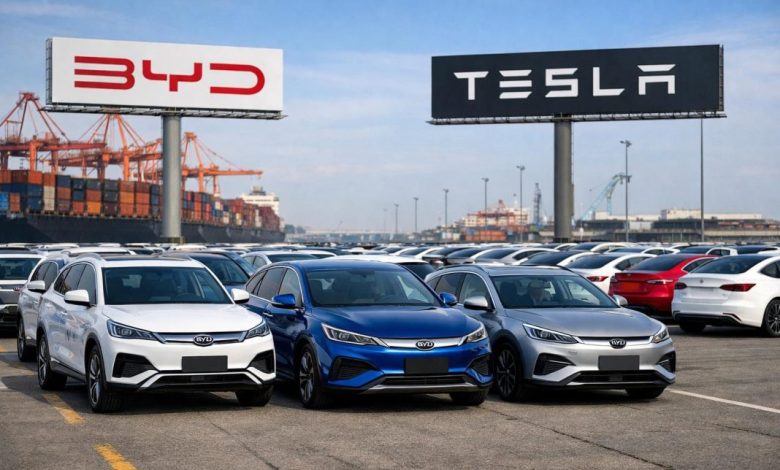
China’s BYD Group is on course to overtake Tesla as the world’s leading seller of electric vehicles in 2026, a development that would signal a major realignment in the global auto industry.
Industry data indicates that BYD delivered more than 2 million electric vehicles in 2025, far ahead of Tesla’s estimated 1.6 million units over the same period. Analysts say the widening gap places the Chinese automaker in a strong position to claim the top spot in annual worldwide EV sales for the first time.
Strong volumes drive BYD’s momentum
BYD recorded roughly 2.26 million EV sales in 2025, the highest annual total ever achieved by an automaker in the electric vehicle segment. The tally covers both fully electric vehicles and plug-in hybrid models, a dual-strategy approach that has broadened the company’s appeal across different markets.
The Shenzhen-headquartered firm has also accelerated its global expansion, ramping up production capacity beyond China while rolling out competitively priced models in new territories. As part of this push, BYD is establishing manufacturing facilities in regions such as Europe to cut trade costs and strengthen its international supply chain.
Tesla faces headwinds
Tesla, which has dominated global EV sales for much of the past decade, is encountering slower growth in key regions including North America and Europe. In these markets, Chinese manufacturers have steadily increased their presence, intensifying competition.
Reports suggest Tesla’s vehicle deliveries in 2025 fell compared with 2024, partly due to softer demand following the expiration of U.S. electric vehicle tax incentives late in the year. While the company remains a leader in areas such as autonomous driving technology, analysts note that its short-term sales momentum has eased.
Shifting dynamics in the EV market
BYD’s rapid ascent highlights a broader shift within the electric vehicle sector, as Chinese automakers expand aggressively beyond their home market. Brands from China are gaining ground in Europe, Southeast Asia and other regions traditionally dominated by Western manufacturers.
Looking ahead to 2026, analysts expect competition across the EV space to intensify further, with pricing strategies, battery innovation and localized manufacturing emerging as key factors in determining global market leadership.
What’s your impression about this story.